Cutting mitered joints using your hand can be time consuming and difficult. Whether you are trimming around a big home, doing a project that requires accurate cuts or running baseboards, a miter saw will make your work easier while improving the quality of your work. Some of the most efficient and most preferred miter saws are Bosch GCM12SD and Milwaukee 6955-20.
Select the type and size of the miter saw that you will require
Miter saws come in different varieties and sizes for different functions. You should therefore choose one that meets your requirements. You can distinguish between Bosch GCM12SD, Milwaukee 6955-20 and other miter saws by looking at the diameter which usually varies between eight and twelve inches. This will help you in determining the thickness and wideness of the material that you want to cut. The Bosch GCM12SD can slide along a horizontal arm and you can push it through the material that you are cutting. This allows a wider and thicker piece of wood to be sawed. The Milwaukee 6955-20 miter saw is efficient as it allows you to tilt the blade to a specified angle; hence you can cut a compound angle.
 Keenly study the different parts of the miter and its function
Inside the bed of the saw, you will find an angle indicator, power
switch, blade guard and angle scale. You will also find a mechanism that allows
you to lock you miter when not in use. Other features such as locking clamps
that secure the work piece vary with saws. Observe them keenly and try to
understand what role they play in the miter.
Start your miter saw
Both the Bosch GCM12SD and Milwaukee 6955-20 miter saws are efficient and can be used for fine tuning joints so that they perfectly fit. Be ready for a startling experience immediately you squeeze the switch of the power handle. As the blade picks up speed, it will whine and jerk. Before you start cutting, wait for the blade to attain its maximum speed. With the Bosch GCM12SD and Milwaukee 6955-20 models, this should take just a few seconds. Slowly and steadily lower the blade through the board until you complete the cutting. While still holding the saw carriage down, release the switch, and ensure that the blade completely stops before you pull it out. Hold the work piece firmly until the blade comes to a complete stop.
Start with scrap material
Place your saw on a receptacle and the piece of scrap material on the bench. To test the saw, start with a small sized scrap material. Ensure that the material is long enough so that it fits securely against the saw's backrest. This will allow you to hold it in position as you continue cutting. Without clumps, cutting short materials can be hard.
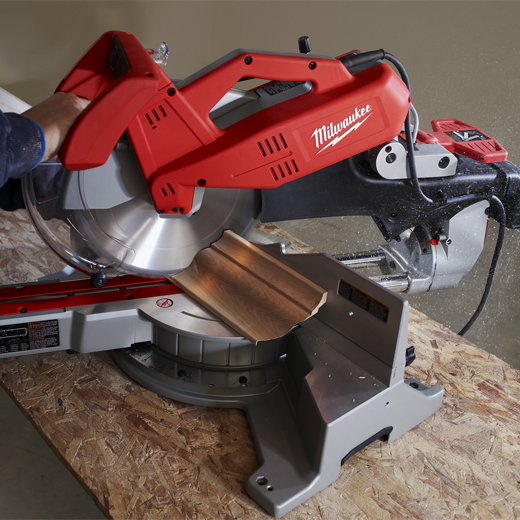
Make several trials until you are comfortable with the saw
Practicing with scrap material will eliminate your chances of making errors with the final material. When handling either the Bosch GCM12SD or Milwaukee 6955-20, you should be able to note that, the blades begin cutting the material near the front, not unless the material is wide. For more accurate results, you can use an angle square to mark the work piece before cutting.
